A record of reads for every source
What the status page must keep about its own reads, for the reader who asks since when a source has failed. The pages as they stand, what readers asked, three options weighed, and the one this paper recommends.
- State
- draft for discussionnot a decision
- Date
- 2026-09-15
- Audience
- The maintainers of the server, the writers of the status pages
- Subject
- The status page and the page of a source in dev-companion 1.4
- Decision by
- 2026-09-30, at the maintainers’ call
The status page says which sources answer, and the page of a source shows the read in flight and the two before it. Readers ask a question neither page can answer: since when, and how often. Twenty-four times in thirty days, and five of eight readers in a test.
Recommendation: option A. The server keeps the last thirty reads of every source in one file, the page of the source shows them as a list under the read in flight, the status row carries the last five as marks, and the terminal prints the count. Six days in five packages. It stays a record of this machine’s own reads, which is what the pages already promise, and not a history of a service, which they refuse on purpose.
1 Purpose
One question, and the evidence behind it. The pages report the moment. Readers ask about the days before it. This paper says what the server must keep so the pages can answer, and what it must not become on the way.
1.1 What this paper decides
If the server keeps a record of its own reads, how long that record is, and where it shows. Three options stand in part 6, and part 8 asks the maintainers for one of them. Everything before that is what the decision rests on.
1.2 What it leaves out
- A history of the source itself. If docs.typo3.org was up is a question about a service, and the status page refuses it on purpose. This paper keeps that refusal; see 2.3.
- Alerts. A read that stops tells nobody. A record makes that visible after the fact, which is a different thing from a message at the time, and a paper of its own.
- The other four sources. The two on this machine and the two that ship with the server never fail a read. The record applies to them and stays empty of anything but "read".
2 Where it stands
The two pages, as a reader sees them in 1.4, read against each other. Then a table for each: what the page says, and what a reader asks of it.
2.1 The two pages
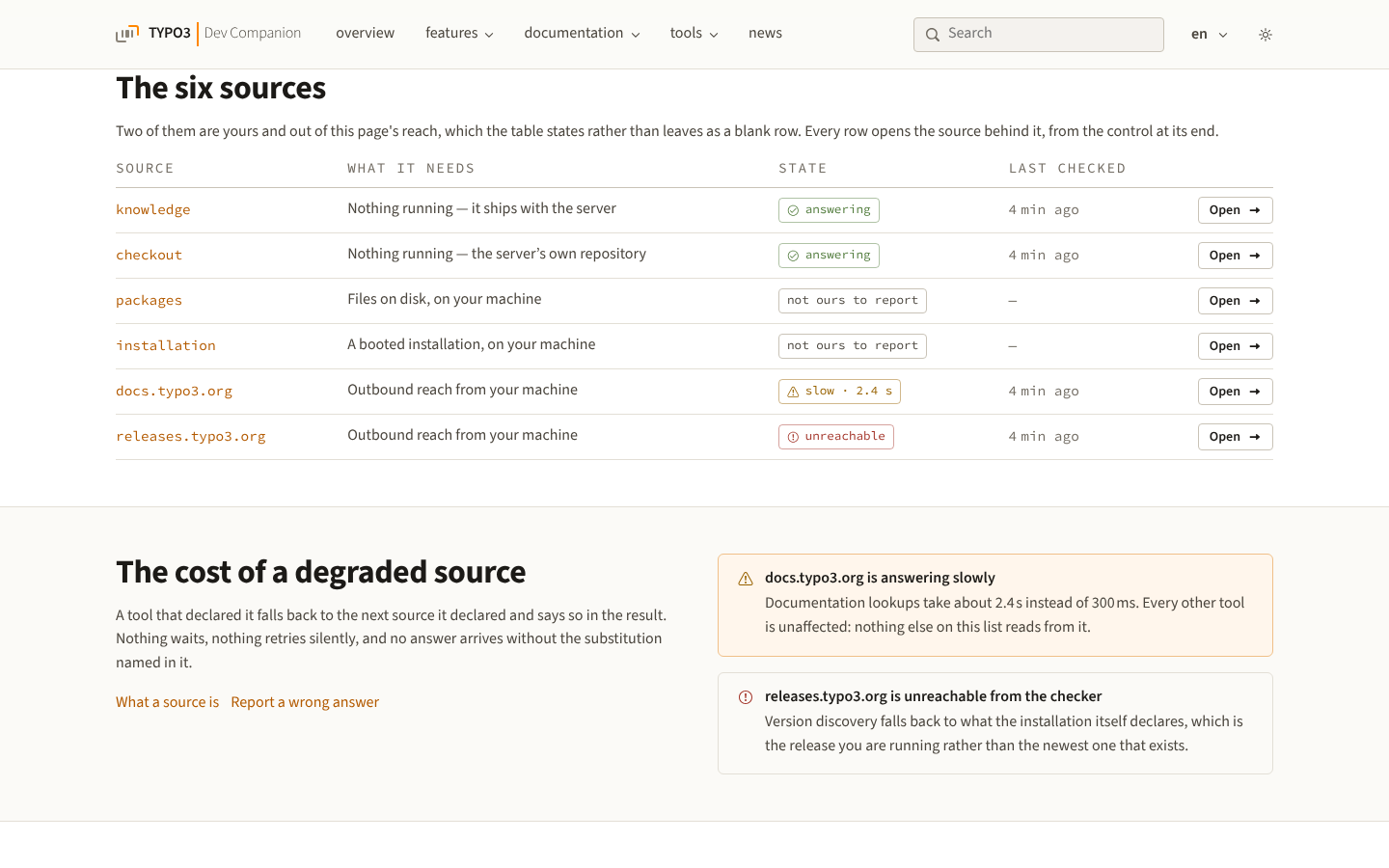
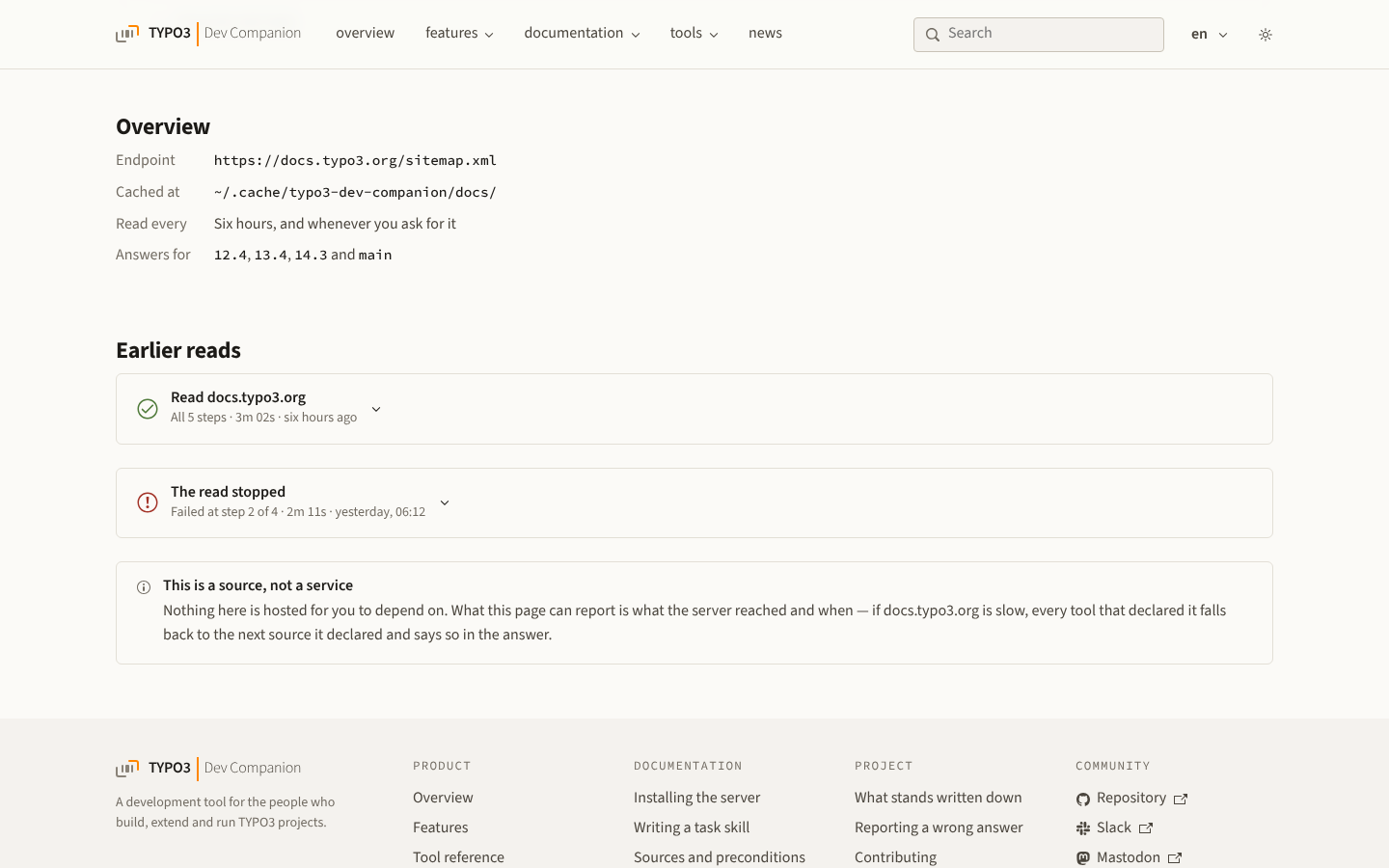
The status page has six rows, one per source: the state now, when the checker last asked, and the way into the source. The page behind a row shows the read in flight, the overview, and "Earlier reads": the last read that ended and the one that stopped. It keeps those two and no more.
The status page
The page of a source
2.2 What the row says
| The row says | The reader asks | Answered |
|---|---|---|
| The state of the source, as a badge | Is it answering right now? | yes |
| When the checker last asked | Did the check run? | yes |
| Nothing about the check before this one | Since when has it been like this? | no |
| Nothing about how often | Is it always this slow? | no |
2.3 What the page keeps
| The page shows | How far back | Enough for |
|---|---|---|
| The read in flight, stop by stop | now | a reader who waits for it |
| The last read that ended | six hours | a reader who wants the last verdict |
| The read that stopped | a day | a reader who asks what went wrong once |
| Nothing before those | — | nobody who asks how often, or since when |
2.4 What the pages say on purpose
The status page ends on a note, and the note is a decision. This paper does not argue with it. It asks if a record of the server’s own reads is the history the note refuses, and finds it is not: the note is about the source, seen from anywhere, and the record is about this machine, and only that.
There is no incident history, because there is no service. Nothing is hosted for you to depend on. What would be an outage elsewhere is a degraded answer here, and the answer says so at the moment it is given.
3 What readers asked
Two kinds of evidence. The questions that arrived on their own, over thirty days, and a test that put eight readers in front of the pages with four tasks.
3.1 The questions that arrived
Every question about the status pages in chat and in the issue tracker between 2026-08-15 and 2026-09-14, grouped by what it asks. The list itself is A.3.
| Question, as it arrived | Times | Where | The page can answer it |
|---|---|---|---|
| Since when is releases.typo3.org unreachable? | 11 | chat, the issue tracker | no |
| Is docs.typo3.org always this slow, or only today? | 6 | chat | no |
| Did the read run tonight? | 4 | the issue tracker | for the last read |
| How long has a full read taken lately? | 3 | chat | for the last read |
3.2 A test with eight readers
Eight people who run the server for their own projects, each alone with the two pages and four tasks, on 2026-09-08 and 2026-09-09. The script is A.1. A task counts as done when the answer is right, and a guess that was right counts as a guess.
| Task | Done | Median | What happened |
|---|---|---|---|
| T1 · Say if the last read of docs.typo3.org ended well | 8 of 8 | 12 s | the page answers it |
| T2 · Find the read that stopped yesterday | 7 of 8 | 31 s | one reader opened the wrong source |
| T3 · Say since when releases.typo3.org has been unreachable | 3 of 8 | 2 min 40 s | five gave up; the three guessed from the two reads |
| T4 · Say how often docs.typo3.org was slow this week | 0 of 8 | — | nothing on the page holds a week |
The two tasks the pages hold an answer for went well. The two that ask about the days before went badly, and in the same way: every reader opened the two earlier reads and looked under them for a third.
3.3 What they said
Two sentences from the interviews after the tasks, each said in some form by more than one reader.
I can see that it stopped yesterday. I cannot see if yesterday was the first time.
The note says it is not a service, and that is fine. I still want to know what my own machine did last week.
4 Findings
What the evidence says, in three groups: what stands in the way of the goal, what costs the reader, and what already does its job and must stay. Every finding in one table first, each row a jump to its entry, and the work they ask for in a second.
| Entry | Kind | Origin | |
|---|---|---|---|
| F1.1 | Nothing on either page says since when | gap | from the questions and from T3 |
| F1.2 | Nothing holds a week, so nobody can say how often | gap | from T4 |
| F2.1 | A reader who found the answer read it off the wrong page | costs | from T3 |
| F2.2 | The row cannot carry a record, and the reader looks there first | costs | from the test, all four tasks |
| F3.1 | Readers find the read that stopped | keep | from T2 |
| F3.2 | The pages say what they are not, and the readers read it | keep | from the interviews |
To do
| To do | Kind | |
|---|---|---|
| W1.1 | Keep the reads before the last two, and show them where the reader asks: on the page of the source. | gap |
| W1.2 | Thirty reads, which is five days at the schedule, and a count of the verdicts over them. | gap |
| W2.1 | The record on the page of the source, so the answer stands where the question starts. | costs |
| W2.2 | Five marks at the end of the row: a glance, and the page for the rest. | costs |
A gap
Nothing on either page says since when
Eleven of the twenty-four questions ask since when a source has failed, and it is the one question both pages cannot answer. The row says what the source does now. The page of the source keeps two reads. A source that stopped four days ago looks like one that stopped this morning.
W1.1Keep the reads before the last two, and show them where the reader asks: on the page of the source.
Nothing holds a week, so nobody can say how often
Every reader failed T4, and every one of them tried the same thing: they opened the two reads and looked for a third. A count over thirty reads answers "how often" for the week the question is about.
W1.2Thirty reads, which is five days at the schedule, and a count of the verdicts over them.
Costs the reader
A reader who found the answer read it off the wrong page
The three readers who answered T3 guessed the day from the two reads on the page and gave the guess as the answer. A guess a page invites is a wrong answer the page gave.
W2.1The record on the page of the source, so the answer stands where the question starts.
The row cannot carry a record, and the reader looks there first
Every reader started on the status page and read the row before they opened the source. A row has room for a glance and no more. Five marks say "this happened before" and not when, and the page under the row says the rest.
W2.2Five marks at the end of the row: a glance, and the page for the rest.
Works as it stands
Readers find the read that stopped
Seven of eight readers found it, in half a minute. The fold under "Earlier reads" is the right shape for one read, and the record keeps it.
The pages say what they are not, and the readers read it
Six of eight readers named the note at the foot of the status page unasked. "It is not a service" reached them. So a record of the server’s own reads does not read as a promise about the source, as long as the page says so.
5 The proposal
The server keeps a record of its own reads, and every surface that shows the reads reads that record. Three surfaces, one file, and a name for what it is.
5.1 A record, not a history
- It is about this machine. A read the server made from here, with the verdict it reached here. Nothing about the source seen from anywhere else, and no claim that it was up or down.
- It is short. Thirty reads, which is five days at the schedule of six hours. The thirty-first drops the first. A year of reads is a history, and part 6 says why that is the wrong thing.
- It says so. The note at the foot of the status page grows one sentence, and the record’s own heading names it: "Reads from this machine".
5.2 What the record holds
One entry per read. Four fields, each the answer to a question from 3.1.
| Field | Holds | Why |
|---|---|---|
| started | when the read began, on this machine’s clock | the answer to since when |
| verdict | read, slow or stopped | the word the row already uses |
| took | how long, or at which stop it ended | the answer to how long lately |
| pages | what the read put in the index | a read that ended well but read nothing is a stopped one |
The record is one file per source, beside the index the reads fill. It lives where the cache lives, so a reinstall keeps it and a cleared cache takes it.
-
typo3-dev-companion/the server’s cache, under ~/.cache
-
docs/one directory per source
- index/what the last read put there
- reads.jsonthe record: the last thirty reads, oldest dropped first
-
releases/
- index/
- reads.json
-
5.3 Where it shows
Three places, from a glance to a sentence. The page of the source carries the record in full, because that is where the question starts (F2.1).

On the page of the source the record stands under the read in flight and above the overview, where "Earlier reads" stands today. The two folds the page keeps become the first two rows. Nothing above them moves.
- The read in flight stays first. A reader who came to wait for it waits there.
- "Reads from this machine" replaces "Earlier reads": thirty rows, newest first. Each row is a mark, a time, a verdict and a duration. A stopped read keeps its fold, and the fold keeps what the stop wrote.
- The overview moves below the record. It changes once a year; the record changes four times a day.
- The note at the foot grows one sentence: what the record is a record of.
5.4 The row on the status page
Five marks at the end of the row, oldest first, one per read. A mark is a colour and a word, as every result in the system is, so the row reads without sight. A row of five green marks says "as always". A row that turns red at the third says "since the day before yesterday", with no number in it.
| Source | State | Last five reads |
|---|---|---|
| knowledge | answering | readreadreadreadread |
| docs.typo3.org | slow · 2.4 s | readreadslowreadslow |
| releases.typo3.org | unreachable | readstoppedstoppedstoppedstopped |
5.5 In the terminal
For the reader who asks from a shell and never opens a page: one line per source, the count over the record and when the last read ended.
$ dev-companion status docs
docs.typo3.org · 30 reads · 27 read · 2 slow · 1 stopped · last 06:00 today
5.6 The setting
One value decides how long the record is. It counts reads and not days, because the schedule is a setting too; part 7 names the risk.
-
reads.keep -
- type
- integer
- default
- 30
- Set in
- settings.yaml, per installation
- Applies to
- every source
How many reads of a source the server keeps. The thirty-first drops the first. Thirty is five days at the default schedule of six hours. A value of zero keeps the two reads the page keeps today, which is the state before this paper.
5.7 What the note says
The note at the foot of the status page grows one sentence, so the record never reads as the history the note refuses. The four lines before it stay as they are.
There is no incident history, because there is no service. …+ What the page of a source keeps is a record of the reads this+ server made from this machine, and nothing about the source+ seen from anywhere else.
6 Options weighed
Three ways to answer the two questions, against what the findings ask. The recommendation is the first column. The third is the fallback if six days is too many.
6.1 The three, in short
The record on the page of the source
Thirty reads in a list under the read in flight. Five marks in the row, one line in the terminal. A record of this machine, on the page that already says what it is.
A page of its own, with a chart
A year of reads, drawn. It answers every question, and it reads as a service somebody watched, which the pages refuse on purpose.
Marks in the row only
Five marks at the end of the row and nothing else. It answers since when for five reads and how often for none.
6.2 Side by side
| Asks | A · The record on the page of the source | B · A page of its own, with a chart | C · Marks in the row only |
|---|---|---|---|
| Answers since when | yes | yes | for five reads |
| Answers how often | for thirty reads | for a year | no |
| Reads with no sight | a list | a chart needs a table beside it | a colour and a name |
| New surface | none | one page, one chart | none |
| Stays a record, not a history | thirty reads | a year is a history | five reads |
| Cost | 6 days | 14 days | 2 days |
6.3 Why not the chart
Option B answers every question and costs twice as much. It fails on the one thing the pages refuse: a year of reads on a page of its own, with a chart, is an incident history with another name. A reader who sees it reads a service.
7 What it costs
Five packages, six days, one order. And what can go wrong on the way.
7.1 Work packages
| Package | What it does | Cost | Needs |
|---|---|---|---|
| W1 | The server keeps the last thirty reads of a source in one file beside its cache | 2 days | — |
| W2 | The page of a source shows the record under the read in flight | 2 days | W1 |
| W3 | The status row carries the last five reads as marks | 1 day | W1 |
| W4 | dev-companion status <source> prints the record as one line | ½ day | W1 |
| W5 | The manual says what the record is and what it is not | ½ day | W2, W3 |
7.2 The order
Decide
The maintainers answer the question in part 8 by 2026-09-30. Nothing below starts before that.Keep the record
W1. One file per source, thirty reads, oldest dropped first. The file is the contract; every surface below reads it. Merged behind a flag, on by default in 1.5.Show it on the page of the source
W2. Under the read in flight, above the overview. The two reads the page keeps today become the first two rows of the record.Marks in the row, the line in the terminal
W3 and W4, in either order. Both read the same file.Say what it is
W5. The manual and the note on the status page say what it is: reads from this machine, not a history.7.3 The dates
The same order on the calendar, and where it stands today.
2026-09-15
Draft 2 to the maintainers
2026-09-30
DecisionNow
Sprint 1 · 2026-10-05 to 10-16
The record, kept
W1
The server keeps the last thirty reads
Sprint 2 · 2026-10-19 to 10-30
The record, shown
W2
The page of a source shows the record
W3
Five marks in the status row
W4
One line in the terminal
2026-11-10
Release 1.5
7.4 Risks
8 Decision
Decision
Does the server keep a record of its own reads, and show it?
Until the maintainers answer, this paper is a draft and the pages stay as they are. The three answers are part 6 in short; the cost of each is part 7.
The record on the page of the source recommended
A page of its own, with a chart
Marks in the row only
8.1 Open questions
- Does the record survive a reinstall? It lives beside the cache, which a reinstall keeps. The paper assumes yes and W1 confirms it.
- Does the row carry five marks on a phone? The table drops the marks where it drops the "last checked" column. To confirm in W3.
- Is thirty the number? Five days at the default schedule. The maintainers can set another before W1; the file format does not care.
8.2 Sources
- The status page and the page of a source in dev-companion 1.4, as shipped.
- The chat and the issue tracker, 2026-08-15 to 2026-09-14; the list is A.3.
- The test of 2026-09-08 and 2026-09-09, eight readers; the script is A.1.
- The manual, “What a source is” , for the sentence the record must not contradict.
9 Appendix
A.1 · The test, as it ran
Eight readers, each alone, each with the two pages open in a browser and a timer beside them. Four tasks, read out one at a time. A task ends when the reader gives an answer or gives up. The median is over the readers who finished.
T1  Say if the last read of docs.typo3.org ended well.
T2  Find the read that stopped yesterday.
T3  Say since when releases.typo3.org has been unreachable.
T4  Say how often docs.typo3.org was slow this week.
A.2 · The record, as a file
[
  { "started": "2026-09-15T06:00:11Z", "verdict": "read", "took": 182, "pages": 18412 },
  { "started": "2026-09-14T06:12:04Z", "verdict": "stopped", "took": 131, "at": 2 },
  { "started": "2026-09-14T00:00:09Z", "verdict": "read", "took": 178, "pages": 18410 }
]
A.3 · The questions, in full
Twenty-four questions from chat and the issue tracker between 2026-08-15 and 2026-09-14, each with the source it names. The table in 3.1 groups them by what they ask. The list stays out of this paper: it names people.