
Forward runs
What a forward review is, and the five of them, are in scenarios/forward/readme.md. This is how a session carries one out.
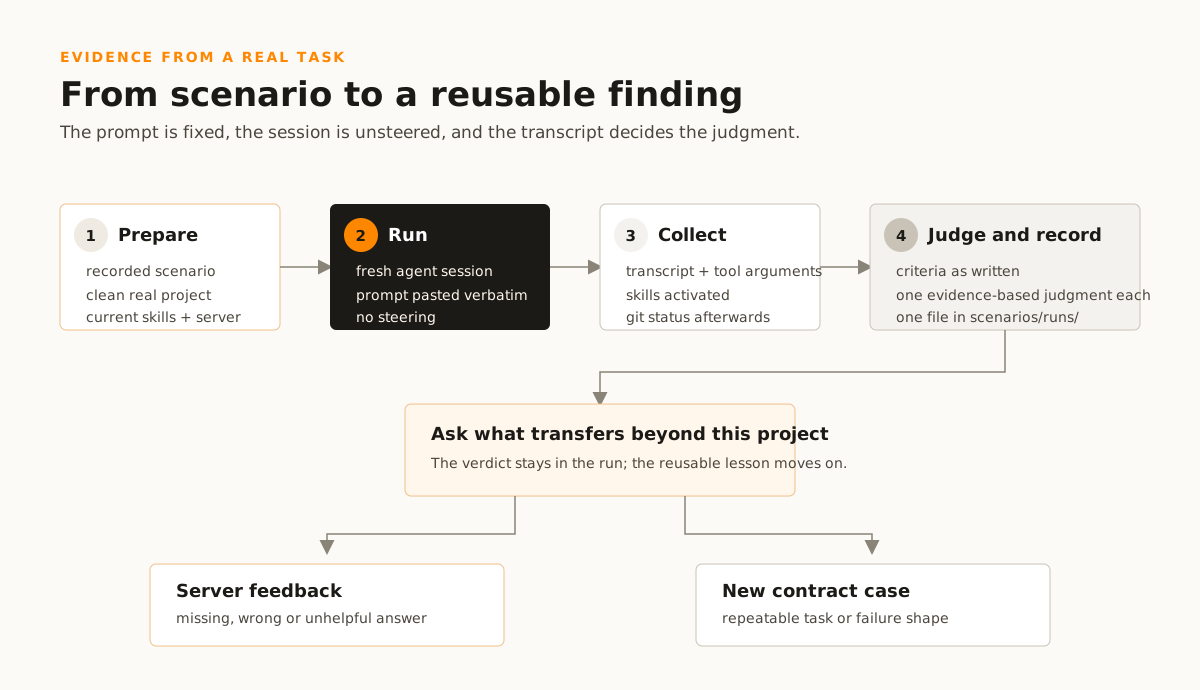
Running one#
- Start the MCP client in the environment the review names. A fresh session,
with the skills published there as they are in this checkout right now. It
need not be a person at the keyboard. A client driven non-interactively is
the same evidence, as long as it gets the prompt and nothing else. What such
a launch has to get right — the session id the judge later needs among it —
is Driving a session nobody types in.
todo/reference/ says which checkout plays which
environment on this machine, and how to reach the client there. A recorded
review runs in one of those and not in the
E-SITEthis repository makes for itself. What a review would find in a scaffold is what this repository put there (D-EVI-004). bin/cli scenarios:record <id> <client>writes the empty run, andbin/cli scenarios:show <id>prints the prompt and the numbered criteria.- Paste the prompt verbatim. Add nothing: no tool names, no hints that a TYPO3 knowledge server is there, no correction when the agent goes the wrong way. What the agent does with an under-specified request is part of the measure.
- Let the review reach its own stop. Do not steer it toward a known subsystem or finding.
- Run
git statusin the environment afterwards, and record what it says. The review itself may not write, which is D-EVI-003 . So a modified tree is one of two things, and both are worth the ten seconds. Either the session overstepped, which is a criterion, or a lookup did. The second is what D-DIS-005 watches for. The registry lookups answer with a boot of the installation in a subprocess. A boot that writes outside the cache is the symptom that decision named and cannot hold itself. Start from a clean tree so the read means something, and note what somebody had modified where it is not. The transcript carries the other half of the same Wrong if. A lookup that answersansweredBy: packagesagainst an installation that was up and configured is a boot that did not finish. A 90-second gap in front of it is the timeout. - Grade against What has to come out of it and How it fails. Write the
judgment and its evidence into the recorded run, together with the skills
that activated and the tools the session called. A call is the name and
the arguments it came with, copied from the transcript,
{}where the tool takes none. The name says a lookup happened, and the question it got is most of what the judgment turns on. One query per surface or one broad one, which version a lookup got, whether the session followed a returned id.bin/cli scenarios:check— andcomposer test— then hold that run to its review.
Judging one#
The grade comes from the transcript, not from what the session felt like. The client stores it as JSONL, one file per session, so which skills activated and which tools the session called are evidence rather than recollection. A handful of the answer's findings are worth a second check against the checkout before the judgment. To grade an answer and to grade a claim are two different things.
- Judge against the criteria as written, not against how much better this
run was than the last. Three
REVIEW-01runs in a row scored four of five while they missed a defect none of the five asked about. The criterion that now catches it exists because somebody wrote the gap down instead of excused it. - Judge the verdict a finding puts on top of its evidence. A run can get
every path, count and line right and still call a design decision a defect.
REVIEW-02waspartialon its first run andcoveredon its second with the same read underneath. - A tool a judgment quotes is one the trace carries.
bin/cli scenarios:checkprints every tool name in a run's evidence that its own trace has no call for. It prints them under the table and outside the exit code. It reports rather than fails because the two cases read alike from there. A judgment that quotes a call the session never made, and one that names a tool in order to say the session never called it.REVIEW-03is the second, and the defect it reports turned up by hand (D-EVI-009). - One change, one run. An edit to the criteria resets the recorded run to
unrunby design. The digest check catches a judgment that answers criteria somebody has since rewritten, so the superseded run survives only in its commit. Name that commit in the new run's feedback. - Reset the environment between runs. A restored work tree is not enough if the session wrote to the database. The next run finds what the last one left and behaves differently.
What a run produces#
The run itself, as one file below scenarios/runs/. The environment, the server it ran against, and the skills the session activated. The tools it reached for and what it asked them, and one judgment with evidence per criterion. The verdict stands nowhere in it. It follows from the judgments. A review whose mark disagrees with what its run establishes is a failed check rather than a sentence nobody rereads.
Everything else a run produces, it produces on top of that — and a run that went
well produces it too. What a run teaches is rarely the verdict. Three
REVIEW-02 runs in two repositories all came out covered or better
against the same criteria. The thing worth a note from them is that not one of
the three executed a single project-owned command. Not one of the answers said
so. That is neither a criterion nor a property of the repository under review.
Left in the run's evidence field, one person reads it once, whoever judged that
run.
So after the judgment, ask what the run taught that is not specific to the one repository. File each answer where the recurring work already walks:
typo3_feedback_recordfor what was absent, wrong, or unhelpful, with the review id in the observation. So a reader can trace the feedback back to the task that exposed it. Give it the run's own prompt as its query, so a later server can take the feedback again the way it takes every other feedback. Give it the model the run ran as, because what a run teaches about behaviour belongs to that model and not to the next one.- A new contract case, when the session exposes a repeatable task or failure shape worth a direct hold. That is the more valuable outcome of the two.
Whoever judged the run writes both of those, from the transcript. When the run happened in an agent whose transcript nobody here can read, the session is the only thing that can report it. It gets an ask for its own debrief after the work ends, and the generic prompt for that is Asking for a debrief. What comes back is weaker evidence than a transcript and the run says so. It is what the session claims about itself, and the answer it gave still gets the usual judgment.
A defect the same session fixes is the exception. That is a requirement and the commit that closed it, not a feedback that would go to the archive on creation. Otherwise the usual route applies. A commit that archives the feedback works it off, and what has to hold afterwards goes into requirements/.
For a gap review, do not re-file the part that is already written down — its
Status today line names the requirement. File what the task needed beyond
it.
A run that hangs#
Treat it as a defect in this server until something else is proven. A client that waits on a tool call that never returns looks exactly like a client that thinks hard, and neither side reports anything.
Measure before theorising. Constant CPU time and a still rchar in
/proc/<pid>/io mean idle rather than busy. No TCP socket in
ls -l /proc/<pid>/fd rules out a wait on the model. Client debug output
names the tool that never came back, which is the whole diagnosis. Two
REVIEW-02 attempts died 24 minutes apart on the first pair of tool calls a
client dispatched at once. The cause was this server, which handed its own stdin
to a console command
(R-DIS-018).