
Asking the installation
Three of this server's answers are not its own. They belong to the installation the caller stands in, and no bundled snapshot could be right about them. This page is the order the server looks those answers up in, and what each step can and cannot see. It says what an answer has to say when it came from the wrong one.
The rules stay in AGENTS.md; what a change assumed is in decisions/discovery/. This is the procedure.
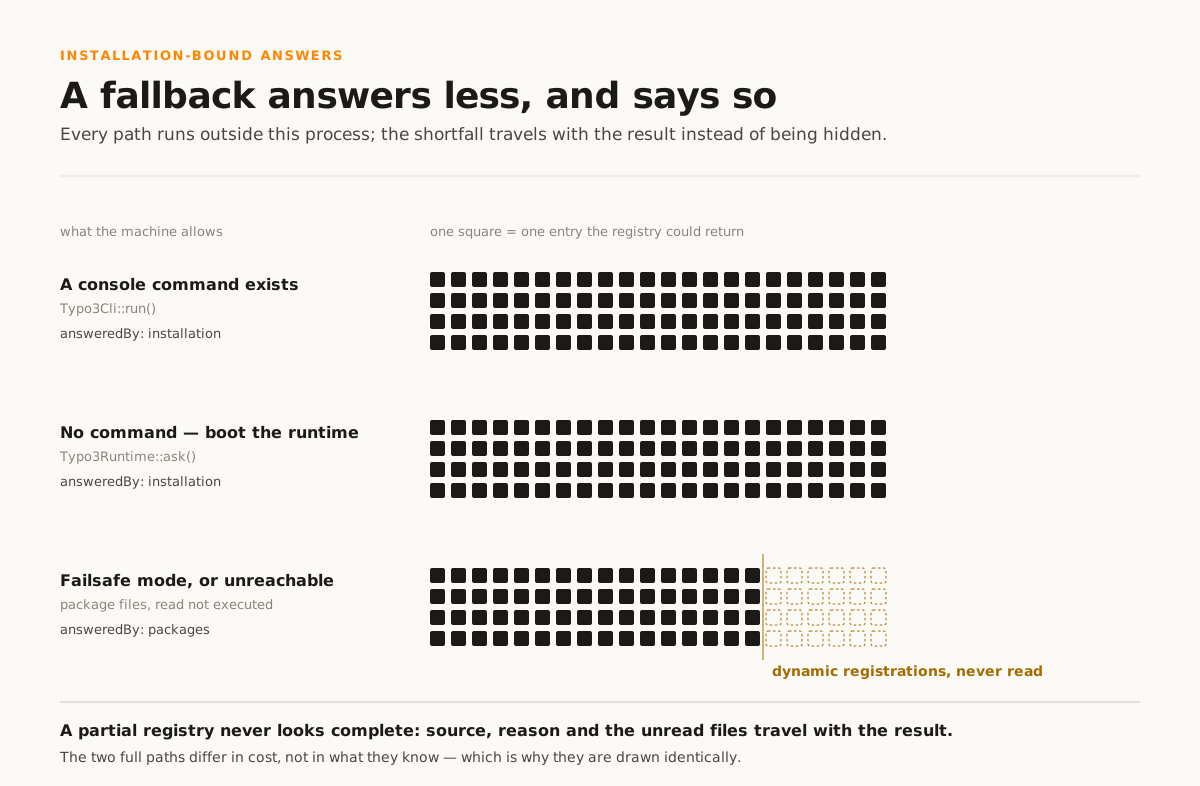
The order#
- The console, where a command exists.
Typo3Cli::run()invokes the installation's ownbin/typo3, through DDEV where the project runs there, for the registries TYPO3 exposes a command for. That islanguage:domain:searcheverywhere, andfluid:namespaceson TYPO3 14 and up, where it exists. -
The container, where none does, or where the command answers less than the registry.
Typo3Runtime::ask()boots the installation in a subprocess and reads the registry itself. This is the only source that knows what a package registers dynamically. The backend modules are the second case.debug:backend:modulesexports neither the navigation component a module resolves to nor its routes. It is TYPO3 v14 and up while this server answers for two lines below that (D-ANS-077). The effective configuration is the third.configuration:showarrived in TYPO3 14.2, so a console answer would leave 12.4 and 13.4 with the console's own "command is not defined" (D-ANS-052). The Fluid namespaces are the fourth.fluid:namespacesarrived in TYPO3 14.2 and the files it would fall back to arrived with it. So below that the container readsSYS/fluid/namespaces, which is where those versions keep the registry (D-ANS-136).The probe reads two topics only where a caller asked for them, because each costs what no other read wants. The whole of
TYPO3_CONF_VARSis around 50 kB of JSON. The resolution of onetype=flexcolumn runs four events, a file read and the TCA preparation behind it. What the caller asked them with goes into the payload the way the autoloader does, as one array. A read taken before goes, so no caller has to ask its topic first. - The files, where the server can reach neither. The registration files the packages ship, parsed and never included. Exact for everything declared, silent about everything else — and an answer that came from here says so.
Nothing in the chain runs in this process. Two Composer autoloaders under one set of class names would take the whole MCP session down instead of one answer. So would a platform check that fails on a PHP this machine does not have. A subprocess brings its own interpreter and fails as an exit code.
The probe#
src/Installation/probe.php goes in as
text, never as an include. Typo3Runtime strips its opening tag, writes the
installation's declared autoloader path into it, and hands it to
Typo3Cli::php(), which delivers it as:
<interpreter> -r 'eval(base64_decode("<payload>"));'<interpreter> -r 'eval(base64_decode("<payload>"));'Three details carry weight, and each of them cost a measurement:
- The interpreter comes from the resolved console. Directly it is the PHP
that satisfied the installation's platform requirement. Under DDEV it is
ddev exec -- php. Behind a statedTYPO3_DEV_COMPANION_CONSOLEthe transport stays and only the binary changes:ddev exec .build/bin/typo3becomesddev exec php. Where the server can derive no interpreter, that is the reason the answer carries. - The payload is base64-encoded.
ddev execjoins its arguments and hands the line tobash, so a payload passes through a shell nobody controls from here. Encoded, it carries no character that shell could act on. Bash expands raw PHP with a$in it before PHP ever sees it. - The autoloader path is relative. The two sides of DDEV share no absolute
path: the subprocess starts in the installation root, and inside the container
that same root is
/var/www/html.
The probe prints one JSON object on stdout and nothing else. It discards TYPO3's own output buffer first, because an extension that echoes during boot would otherwise sit in front of the payload.
The three states#
fullfailsafeunreachable| State | What it means | What is done with it |
|---|---|---|
full |
The container came up with every extension in it | It is the answer, and it is remembered for the session |
failsafe |
TYPO3 booted without essential configuration: core packages only | Never handed on. The files answer, and the reason travels with them |
unreachable |
No console, no interpreter, or the boot failed | Same — the files answer, with the reason |
Failsafe is the state to know. Bootstrap::init() turns it on when
checkIfEssentialConfigurationExists() fails, which is the ordinary condition
of an extension repository. composer install has run, there is no
settings.php, and there is no database. Every registry still answers,
isLoaded() still says true for the extension under work, and what comes
back is a core-only subset that looks complete. Measured against
georgringer/news: 1259 icons, not one of them the extension's own.
The server remembers only a full read. A caller that reads "the DDEV project
is stopped", starts it, and asks again must get the better answer in the same
session. That is the same rule Typo3Cli::resolve() and
Instance::describe() follow.
What an answer owes#
Every answer says which source it came from, in one vocabulary: answeredBy
is installation when the installation itself answered and packages when
its files did. Where it is packages, the answer also states what that leaves
out and why the read went that way. It says so in the text and not only in the
data. A caller that reads the matches would skip a line of its own. A registry
that reads as complete is what makes a review report defects nobody has.
The reason is half of it. The other half is which files it cost. A section a
tool leaves out because it is empty says the same nothing in two cases. The file
does not exist, or it exists and builds its list while it runs. Only the second
is a casualty of the degradation. typo3_extension_describe carries those in
notReadStatically and names them in its text; anything else that parses a
declaration file owes its callers the same distinction.
Checking it by hand#
The suite cannot boot TYPO3, since this repository has no core and never will.
So Typo3RuntimeTest holds everything around the boot. That the payload
reaches an interpreter and answers as data, and that the autoloader path is the
declared one. That every state that is not full arrives as a reason. A check
of the boot itself runs by hand against a set-up installation:
php -r '
    require "vendor/autoload.php";
    TYPO3\DevCompanion\Installation\Instance::discoverFrom("/path/to/a/site");
    $answer = TYPO3\DevCompanion\Installation\Typo3Runtime::ask();
    printf("%s %s\n", $answer["state"], $answer["reason"]);
    print_r(array_map("count", $answer["topics"]));
'php -r '
require "vendor/autoload.php";
TYPO3\DevCompanion\Installation\Instance::discoverFrom("/path/to/a/site");
$answer = TYPO3\DevCompanion\Installation\Typo3Runtime::ask();
printf("%s %s\n", $answer["state"], $answer["reason"]);
print_r(array_map("count", $answer["topics"]));
'A site with an extension that registers at runtime is what makes the check worth a run. If its identifiers are in the topic, the container answered.