
Which versions an answer holds for
The rule is in AGENTS.md: a statement that does not hold on every covered TYPO3 says so as data. This is the form of it, and what follows from it.
knowledge/versions.json and nowhere else declares which versions the server
covers. Every check that needs the list reads it from there.
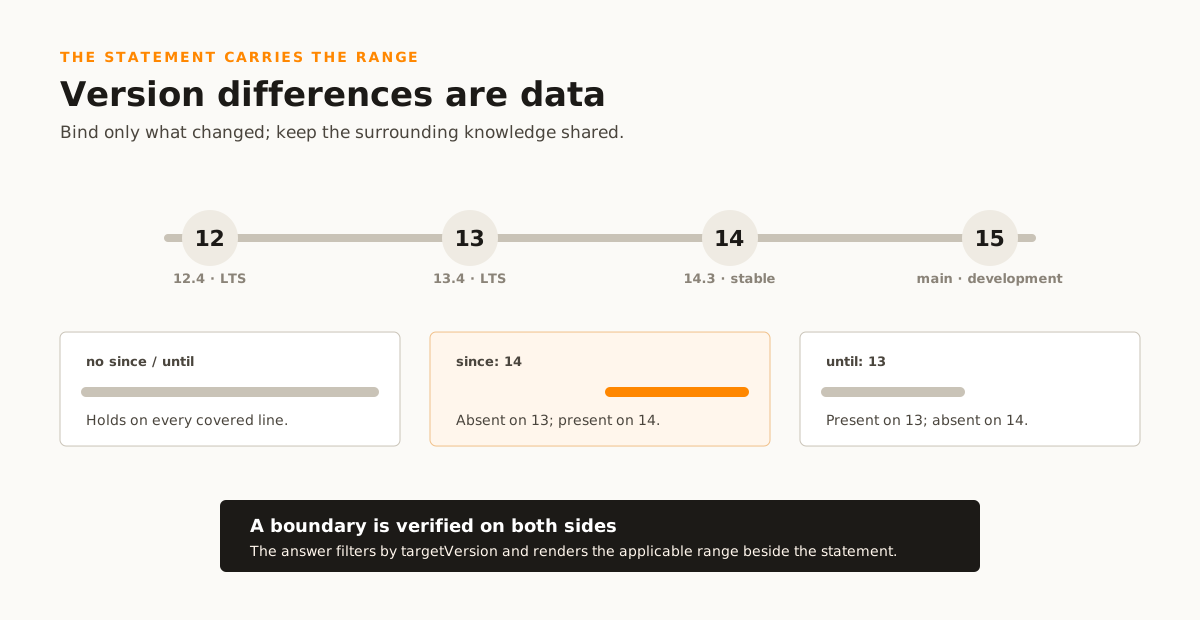
A statement that does not hold on all of them says so as data, not as prose.
since and until carry the major it starts and stops to hold at, and the
answer renders that beside the sentence. A statement without either holds
everywhere the knowledge base reaches, which is what most of them do.
"hints": [
  "Template files below Resources/Private/ are resolved by the view factory.",
  { "text": "A label is referenced by its translation domain.", "since": 14 },
  { "text": "Every content column needs an explicit identifier.", "since": 15 }
]"hints": [
"Template files below Resources/Private/ are resolved by the view factory.",
{ "text": "A label is referenced by its translation domain.", "since": 14 },
{ "text": "Every content column needs an explicit identifier.", "since": 15 }
]That is the whole mechanism, and it exists because the alternative is worse. A
caller on an LTS with a main answer changes code that then fails at runtime,
and the failure is silent. Everything else on this page follows from it.
- Bind the statement, not the hint. A subsystem does not change wholesale; one sentence in it does. Splitting a hint per version duplicates the six statements that did not change.
- The writer verifies a bound statement on both sides of its boundary.
since: 14means a check against 13.4 found it absent, and a check against 14 found it present. Name both branches in the commit message — that is the evidence nobody can reconstruct later. - Split a narrowed statement before binding it.
untilsays the sentence no longer holds. So a subject that survived under a new condition needs two statements. The unbound half that still describes it, and the bound half with what arrived. Bound whole, the half that survives reads as removed, and the range is contiguous either way so nothing sees it —D-VER-006. - Prose stays free of version numbers. The bound is in the field, so the
sentence does not need "since v14" in it. Nothing can filter, re-render or
check a sentence that carries one.
HintsTestenforces this. - State the shape that is current, not the history it replaced. A bullet whose payload is "X is deprecated" becomes a bullet whose payload is "this is what new code looks like". The bound is the version the new shape arrived in. The predecessor is then implied and stays a clause, not a bullet of its own.
- Where an area was rebuilt underneath, the hints say so themselves. A route
to
typo3_changelog_lookupfor what the version changed here is a call a session under time pressure skips. What it acts on instead is the statement that described the area before it moved. - Where the answer is branch-specific in a way a range cannot express, give
the procedure, not the result. Name what to read in the checkout — an
@deprecatedannotation, atrigger_error(..., E_USER_DEPRECATED)call,Documentation/Changelog/, the extension scanner matchers. What a given version deprecated is a list; how to find it is a procedure. - No concrete changelog file names, no counts. Both are a snapshot of one checkout and go stale silently. Counts measured while the author writes a hint are evidence for the author and belong in the commit message, not in the answer.
- "Check whether X" is not a hint, it is a check.
hintscarries statements,checkscarries commands that run. A check-shaped sentence with no command behind it tells the caller nothing it did not know already. - Who owes it is data as well. A version range is not the only thing an
answer has to know per caller.
binding: "core"marks what is a condition of a patch to the core and a convention anywhere else. That is the backend's own design system, the changelog artifact, the paths of the mono repository. It sits on the hint where the whole subject is that, and on the single statement where one sentence in an otherwise transferable hint is. Nothing goes for it. Outside the core the content stays and carries the marker, because a project that builds a backend module wants exactly those rules. Absent is the ordinary case and means it holds wherever somebody writes TYPO3. An API that throws throws in a sitepackage too.VersionsTest::whoIsObligedIsWrittenAsDataTooholds the vocabulary to that one value; a second one is a decision, not a data entry. - The catalogs carry the same binding, and it decides. A
knowledge/catalog/entry is markup taken from one revision, sosince/untilthere is the whole entry rather than one sentence.targetVersionwithholds it instead of a qualification, since a class that does not exist fails in a browser, silently. The bound derives from the checkouts, no judgement.bin/cli components:checkre-reads every covered checkout and reports each entry whose recorded range no longer matches, so a core update invalidates it loudly. It derives from names, so a demo rewritten around the same classes reads as unchanged. The entry records a digest of what each covered demo said, and the same command fails on a rewrite no name would show (D-CAT-001). - A class the query names is a second question, and carries its own range.
What withholds an entry is usually a custom property that arrived after the
classes beside it. A caller that borrowed one backend class asks where that
class goes rather than for something to paste. So each class carries the
majors it exists on and where it sits: around the component, on it, or inside
it. A class named outright gets an answer below the entry's own bound, never
as markup (
D-CAT-006,D-CAT-008). - Where a class sits is itself version-bound, and it derives from the
checkouts.
bin/cli components:derivereads thebackend.csseach covered branch commits and writes the position and the range of every class the catalog names.bin/cli components:checkre-derives and fails where the committed state has fallen behind. A read of four committed files is the verification, so no installation takes part and nobody keeps a range by hand (D-CAT-008). - A directory is not evidence that what it demonstrates is inside it. Where
a worked example promises a shape rather than a path, the entry names the two
or three files that carry that shape in
files. The range derives from those as well. A rewrite that keeps the directory and moves what is in it is otherwise exactly what a range on existence cannot see (D-CAT-007).