
Working on the server itself
For someone who changes this repository rather than uses it. The conventions are in AGENTS.md; these are the commands they rest on.
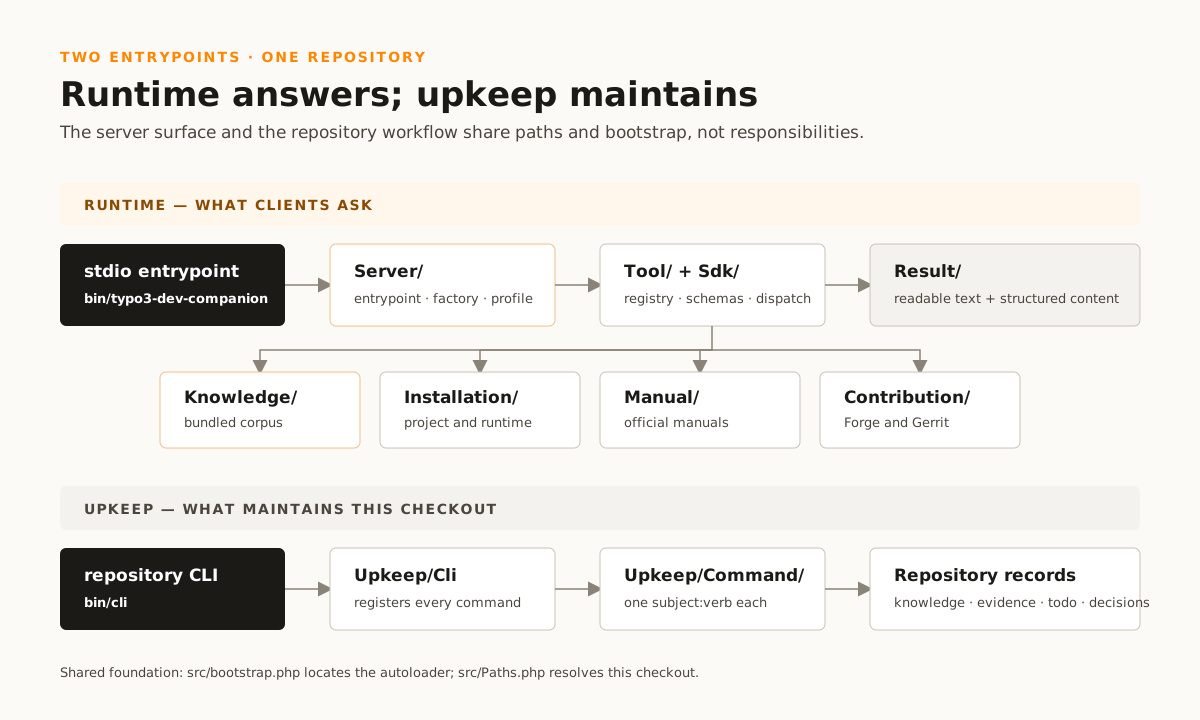
The upkeep CLI#
Everything that keeps this repository in order is one command. The requirement and decision files, the forward-run scenarios, the hint corpus, the bundled catalogs, and the core checkouts below. Run it with nothing and it says what it supports:
bin/cli                   # every command it carries, grouped by subject
bin/cli todo:next         # the one todo that is due now, and nothing else
bin/cli entries:lookup <path>  # what is written about the code you are about to change
bin/cli repository:check  # requirements, decisions, scenarios and the todos against their formats
bin/cli help <command> # what one command takes, and what each argument isbin/cli # every command it carries, grouped by subject
bin/cli todo:next # the one todo that is due now, and nothing else
bin/cli entries:lookup <path> # what is written about the code you are about to change
bin/cli repository:check # requirements, decisions, scenarios and the todos against their formats
bin/cli help <command> # what one command takes, and what each argument isbin/typo3-dev-companion is the server itself and carries none of this.
Every command prints in one voice, and Voice is the class it is. A heading
in bold, rows under it, a verdict at the end with a green or a red mark before
it. A problem on the error stream, and a note in grey for what is context rather
than answer. A command that takes long draws a bar over its steps. The colour
and the bar are for a terminal, so a pipe, a log and --no-ansi get the same
words without them — D-DOC-067.
Core checkouts#
The knowledge has TYPO3 versions as its bound, so a writer checks a statement on
both sides of the boundary it claims. knowledge/versions.json declares the
covered lines, and one command turns them into checkouts this repository owns:
bin/cli checkouts:update   # create what is missing, update what is there
bin/cli checkouts:status # what exists, at which revisionbin/cli checkouts:update # create what is missing, update what is there
bin/cli checkouts:status # what exists, at which revisionThey land below .checkouts/, which git ignores. One treeless clone plus a
worktree per version, so four lines share one object store (under a gigabyte in
total). Nothing at runtime reads them. They are how a writer verifies the
knowledge, not where the answers come from.
One command here does answer from one: bin/cli tools:record records the tool
pages against the newest released checkout. So a checkout with anything in it
checkouts:update did not put there, a composer install first of all,
gets a refusal rather than a record. D-DOC-034 is why.
Those recorded pages are also the only corpus that says what an answer costs the
caller who asked for it. bin/cli tools:measure reads them and prints the
text bytes and the data bytes per tool, worst first. The data counts as the
compact JSON a client hands the model. Above them it prints each definition as
tools/list carries it, the output schema apart, largest schema first. So a
trim starts at the top of a list rather than at whichever tool somebody noticed.
It calls nothing and fails on nothing. A long answer can be the right one, and a
split of a tool in two would answer a counter that failed.
Which half a client hands the model is the client's, and D-EVI-011 measured
two. Claude Code hands over the data and drops the text. opencode hands over the
text. Neither hands over the output schema. bin/cli tools:tokens measures it
again in Claude Code: it runs claude -p three times through
bin/cli tools:proxy, which relays the server with structuredContent or
outputSchema taken away, and reads what the tool_result carried and what
it cost off the trace. It costs money and half a minute, and it needs claude
on the machine.
The same command keeps the packages the core pins rather than contains.
typo3/testing-framework, the harness a project extension tests in
(D-KNW-106), and typo3fluid/fluid, the engine that parses a template
(D-KNW-146). Which release line belongs to which major stands nowhere. Each
covered branch pins it in its own manifest, the harness in require-dev, the
engine in require. One worktree per pinned line stands at that line's newest
tag. So a writer verifies a statement about either in
.checkouts/<package>/<line> the way a statement about the core in
.checkouts/<branch>. bin/cli checkouts:verify re-reads them.
Scenario environments#
A case only means something in the work directory it names. This checkout makes
two of the five scenarios/readme.md defines rather than finds them on the
machine:
bin/cli environment:status             # which ones this checkout has, and which are missing
bin/cli environment:create E-SITE      # a DDEV project with TYPO3 installed in it
bin/cli environment:create E-SITE 13.4 # the same, on another covered version
bin/cli environment:create E-NONE # a directory with no installation above itbin/cli environment:status # which ones this checkout has, and which are missing
bin/cli environment:create E-SITE # a DDEV project with TYPO3 installed in it
bin/cli environment:create E-SITE 13.4 # the same, on another covered version
bin/cli environment:create E-NONE # a directory with no installation above itThey land below .environments/, which git ignores. E-SITE is a run of
ddev commands. A TYPO3 project, its containers, TYPO3's own base
distribution at the version you ask for, the system extensions this server's
console path asks for. The setup that writes the database, the admin user and a
site configuration. Last the extension of the project's own, one table with rows
in it, which a base distribution registers nothing of (D-EVI-010). Minutes
on a cold Composer cache, seconds on a warm one, and a second run finishes one
that stopped halfway.
There is one installation per covered version, each its own directory and its
own DDEV project. The version named none is the covered stable one. Asked for
one that already exists the command starts its containers and puts that
extension in rather than builds anything. So an environment comes once and
stays, see D-EVI-006, which also has what one costs on disk.
The development line is one of them and has a different build. It comes from the
base distribution's dev-main at a dev stability, on PHP 8.5, because that is
what its core declares. It is the only line on which anybody can see this
server's answers about the next major at all. It moves under the machine daily.
Nothing re-makes it, so ddev delete and create again is what refreshes
it.
What it is for is a directory in which ddev exec vendor/bin/typo3 … answers.
That is the half of this server that no test reaches, and where a real run found
both D-DIS-007 and R-DIS-018 instead. What it is not for is a recorded
forward review. A scaffold's defects are this repository's own, so a review
still runs in a real project. The other three environments say where they come
from when you ask for them, and the reasoning is D-EVI-004.
The published documentation#
This directory goes out as a site, and nothing else in the repository does. The
site opens on the manual's own page and the checkout's
readme.md is a file it does not carry (D-DOC-026). The generator writes
a copy rather than these files.
This repository writes the copy and stops there — D-DOC-028. The
renderer is a build tool and none of it sits in this repository. So a deployment
prepares the copy and installs a renderer of its own. Locally that is one
command, which fetches the renderer into .site/renderer the first time and
reuses it after:
bin/cli documentation:preview         # the whole site, into .site/html
php -S localhost:8000 -t .site/html # read it at http://localhost:8000/bin/cli documentation:preview # the whole site, into .site/html
php -S localhost:8000 -t .site/html # read it at http://localhost:8000/--watch is both of those in one terminal. It serves the site on the port
--port names, 8000 unless told otherwise. It renders again after every save
below documentation/ or skills/, says which file it saw, until Ctrl-C
takes the server down with it. A render draws a bar over its steps, and the save
that finishes a half-typed directive renders over the one that failed on it. The
server reads the pages from disk on every request, so a reload is all the
browser needs.
bin/cli documentation:prepare is the first of its steps on its own — the
copy, into .site/source, with no renderer, no theme and no network. That is
what .github/workflows/documentation.yml runs before installing a renderer
into the runner's own temporary directory.
The order is not a choice. The renderer publishes the copy rather than these sources, so a render before a prepare renders the previous one. The theme's finish step reads the pages the renderer has just written. It is what copies the stylesheet, the script and the faces beside them and writes the index the search bar fetches. The workflow spells the same three steps out, which is the one thing here written down twice.
Delete .site/ to render against the theme as it stands. The preview keeps
the renderer it fetched, and a deployment resolves it fresh on every run.
Read the site over a server rather than open .site/html/index.html. The
search fetches its index as a file beside the pages, and a browser refuses that
fetch over file://. Everything else on the page survives it, so a site
opened from disk looks whole and has no search.
87 of the links here point at a decision, a requirement or a class, and a
visitor of the site has none of those. The copy turns each of them into the file
on GitHub and leaves the rest as they are. So these pages keep the paths a
reader of the checkout follows. It also publishes every readme.md as the
index.md a generator serves as the directory itself. It drops the heading a
link names in another page, which this renderer answers with a dropped link.
What that costs is D-DOC-017.
The renderer is phpDocumentor Guides, configured in guides.xml. Nothing here
requires it. The step asks for one package, typo3/soul-guides-theme, and the
renderer comes with it. Resolved into this package's own require-dev it
would add 34 packages to every composer install. So it lands in a directory
of its own instead (D-DOC-028).
That configuration sits beside the pages, as documentation/guides.xml. That
is where a TYPO3 extension keeps its own and where -c documentation names it
on the render step. Everything else stays relative to the work directory, the
input and output it declares, the renderer, the finish step. That is why
both commands run at the root. It is the one file below documentation/ that
is not published: D-DOC-027.
What the page looks like is not this repository's to invent, and no longer
this repository's to carry either. The design system publishes itself as a
theme for this renderer. The layout, the stylesheet, the script, the two
families, the icons and the search all ship inside that package. What stood
here, a layout, a stylesheet, a script and an asset build of its own, is gone.
What remains here is guides.xml. Everything the bar, the tab and the footer
say stands in it rather than in a copied template. D-DOC-024 is the move. It
revokes D-DOC-023, which vendored the same system by hand.
The front page is the one page set in that theme's marketing layout —
D-DOC-030. :layout: marketing stands above the title, because the parser
takes a field list as metadata only while it has found no title. What follows is
a run of band directives with the page's claims in them. What a band, a
grid, a card and a surface take is
the theme's own manual;
nothing here renders any of them.
Two things in guides.xml carry weight. theme="soul" selects a theme that
has to exist first, and the extension element below it is what makes it exist.
automatic-menu is the other. The rail and the trail are a toctree in
this renderer, which is a reStructuredText directive this markdown corpus cannot
write. With it on, the same tree comes out of the directories instead. So
every directory of this documentation needs its own ``readme.md``. A page
whose directory has none attaches to nothing and lands in no menu at all, which
SiteTest::everyDirectoryOfTheDocumentationHasItsOwnPage stops.
The mark is this repository's own drawing and lives with the pages, as
images/signet-s.svg, -m and -l. A signet gets a new drawing per
optical size rather than a scale, and a browser picks between them by the slot
it needs. Server\Factory sends -s and -l to a client at
initialize as the server's icons, so a client lists it under the same mark.
Each follows the form the system asks of artwork, one var() with a hex
fallback per shape, and the whole drawing under one id. So a mark referenced
into the page carries the page's own ink and the file still renders on its own.
One thing the local preview cannot show is the type. The faces are
font-display: optional, so a browser uses one only where it is already in
the cache. That is what stops a second layout of the wordmark on every
navigation. It is also what makes php -S render the whole site in the
fallback, since it serves no cache header. What is deployed does.
.github/workflows/documentation.yml runs all of it on every push to main
and deploys the result to
GitHub Pages. It needs
Settings → Pages → Source: GitHub Actions on the repository. A deployment
from a branch serves the root or /docs, and this directory is neither. Node
is there for the finish step alone, which is one bundled file and installs
nothing.
The drawings are the open half. A markdown image is an inline node, and the
theme renders a figure for the reStructuredText directive alone. A plain
<img> is a document of its own that cannot learn which mode the page is in.
So a reader in dark reads a light drawing, and a drawing appears at the width of
the column rather than at its drawn size. What each would need is in
D-DOC-024.
Tests#
composer ci      # lint, coding guidelines, static analysis, tests — what CI runs
composer test    # phpunit only
composer stan    # phpstan only
composer cgl # bring every PHP file to the guidelines; cgl:ci only reportscomposer ci # lint, coding guidelines, static analysis, tests — what CI runs
composer test # phpunit only
composer stan # phpstan only
composer cgl # bring every PHP file to the guidelines; cgl:ci only reportscomposer ci lints, checks the coding guidelines, runs the static analysis,
and runs the test suite. That is the search and ranking logic, every tool
against its declared schemas and annotations, and the stdio entrypoint driven as
a real subprocess. CI runs the same command on every supported PHP version.
A test that holds a decision or a requirement says so where it is.
#[Decision('D-DOC-048')] and #[Requirement('R-COD-003')] over the
method, or over the class where the class as a whole is the answer.
bin/cli decisions:cover and bin/cli requirements:cover write the entry's
coveredBy and heldBy from those attributes. The checks fail on a copy
that says anything else, so the entry cannot name a test somebody renamed away.
A failed run ends with the entries the failures held, each with its title and
its path. That is what sends the session that made a test red to the entry
rather than to the assertion.
The guidelines are php-cs-fixer's, in .php-cs-fixer.dist.php and nowhere
else. PER-CS 3.0 plus the handful of rules this repository writes by. Strict
types declared, imports sorted with global classes left unimported, single
quotes, a comma after the last item of a multiline array. cgl rewrites the
files and cgl:ci reports what it would rewrite. That is the half ci runs
because a check may not change the code it judges.