
The records, and where they live
Four files hold four different kinds of thing, and their separation is what keeps any of them readable. AGENTS.md has the rules; this is what each one is for and how the work moves between them.
The pages that carry one of those steps out:
- Judging a feedback — what a session asks of one open feedback, in which order and on what evidence.
- Working a todo — what a session reads before it changes the todo
bin/cli todo:nexthanded over, and what the queue says afterwards. - Working several todos at once — how several sessions get different todos, where each writes, and how it comes back.
- What a requirement is and Writing a requirement — what one states, and the sections it consists of.
- What a decision is and Writing a decision, and going back to one — what one carries that a commit message cannot, and what a later session adds to its foot.
- Forward runs — how to run a forward review, judge it, and read one that stopped without an error.
- Asking for a debrief — the prompt a session in somebody else's agent gets once the work ends, and why it asks what it asks.
Where a session starts#
bin/cli todo:nextbin/cli todo:nextOne todo, not the queue and not everything nothing has answered for. Context is not free: a session handed all of it reads for ten minutes and then starts with a summary of what it read.
Due is two questions. Has the clock come round, which the todo's every:
answers. session, or a number of days, so five sessions in an afternoon do
not ask the same question five times. And is there anything to do, which the
todo's run: command answers with a nonzero exit when it found work. The
sighting stops to be the next thing the moment the last entry has a name, and
nobody edits a todo to say so. A feedback or an unresolved entry has a claim on
that judgement. A todo that takes it on, or the sentence that says why it stays
as it is. Not the work itself, which is what the queue is for.
The queue comes first#
For a while it did not, and the effect is worth a record. A todo that recurs
every session is due for as long as anything waits for a judgement, and next
asked the recurring ones first. Feedback arrives from every session everywhere
while one session closes a handful. So every session opened on the same sighting
and no session reached the queue behind it. Entries sat in it untouched for as
long as feedback/ was not empty. That is always.
The order is now: what has a clock, then the queue, then the sightings once the queue is empty. It follows from what a judgement is. To judge a feedback is to decide whether it becomes work. The queue is the work that decision produced.
Since 2026-08-02 the feedback are in the queue rather than behind it. One card
each, written as the feedback arrives at low, which is below everything
somebody has judged to be worth more. The order stays and what enforces it has
moved. The priority does it now, where a group boundary did it before. What is
still behind the queue is the sighting of what nothing answers for, and a
session reaches it when the queue runs dry. That now means that nothing decided
remains and nothing has arrived without a judgement. A sighting left in place
in order to judge more feedback decides twice and does nothing. The pile it
decides over grows faster than any session can read it.
The second half of the same problem is the size of the read, and the board is
what solves it now. Every open feedback has one card, and bin/cli todo:next
hands over one of them, like any other todo. A fresh card is low, so the
oldest feedback without a judgement comes up once the decided work ends. A
session that also has work of its own can re-run one query. It cannot re-run
sixty-seven, and a session with all of them in hand closes whatever is easiest.
The portion was five until 2026-08-02, cut for a reader who could then only find
the judgements in the commit that made them. What carries that instead is
decisions/, which is where a judgement goes now, see Judging a feedback and
D-FBK-012.
bin/cli feedback:list is still the whole of it, for whoever wants the
overview.
What writes the card is typo3_feedback_record, in the same call that stores
the report. The feedback and its card land together, wherever the session that
records it stood. Nothing has to run afterwards for the board to be right, see
D-FBK-045.
Nothing writes one afterwards. A bin/cli todo:sync did until 2026-08-14, run
from a pre-commit hook on any commit that touched feedback/. Both went with
the write that made them necessary. A repair kept for a case the record no
longer produces is a second way for a card to come about. The hook was the half
that only ever ran in this checkout
(D-FBK-022,
revoked). What remains is the report. bin/cli todo:check and CI name an open
feedback no todo answers for, one added by hand, or one whose card went while it
stayed open. The repair is a card written into todo/open/.
What next can never do is a run of a feedback's own query against the server
as it is now. A feedback is evidence about a version of this server that may no
longer exist, and that read is the session's.
Working the todo#
Everything on this page is about the order of the work. One page of its own
covers what a session reads before it changes the todo at the front. It says why
the session judges the step rather than executes it. Also where it settles a
question the work turns on instead of recalls it. Also what it asks because
nothing here can answer it. That page is Working a todo, which
bin/cli todo:next names with every todo it hands over.
Keeping the queue current#
- A change of order goes into the file before the work starts, so the reason exists there rather than in a session that has ended.
- New work found along the way becomes a todo that names what it serves. If it serves nothing yet, it is an idea and belongs in the feedback that had it.
What the commit that finishes, trims or puts back a todo leaves behind is the last section of Working a todo. How to write a todo is todo/readme.md itself.
What a feedback carries#
A feedback arrives because somebody asked for one. A session in a client this repository cannot read reports its own run, and Asking for a debrief is the prompt it gets after the work.
Each one names the work directory the session that left it ran in, as
directory: in its front matter. So a check of a gap runs against the project
it turned up in rather than against whatever is at hand. It is the same
directory the stdio entrypoint hands to instance discovery; a feedback left over
an endpoint that has none carries none. That directory is also why the answer
reports the feedback back as an absolute path. It goes into this server's
checkout and not into the project the session is in. A relative path sent to a
caller somewhere else reads as a write that failed.
It also carries model: — the model that left it, as it named itself. Much of
what arrives is about what a session did rather than about what an answer said,
and that is one model's behaviour. Without attribution, two models' habits are
one undifferentiated report and nobody can work either off. The write never
fails on it. A model that does not know its own identifier has to send
unknown rather than an invented one. So a feedback nobody can attribute says
so.
Both feedback tools exist only in a standalone checkout. Installed as a
Composer dependency the package lives in vendor/, where the next
composer install would lose anything written there. There the server stays
strictly read-only and neither tool appears in tools/list.
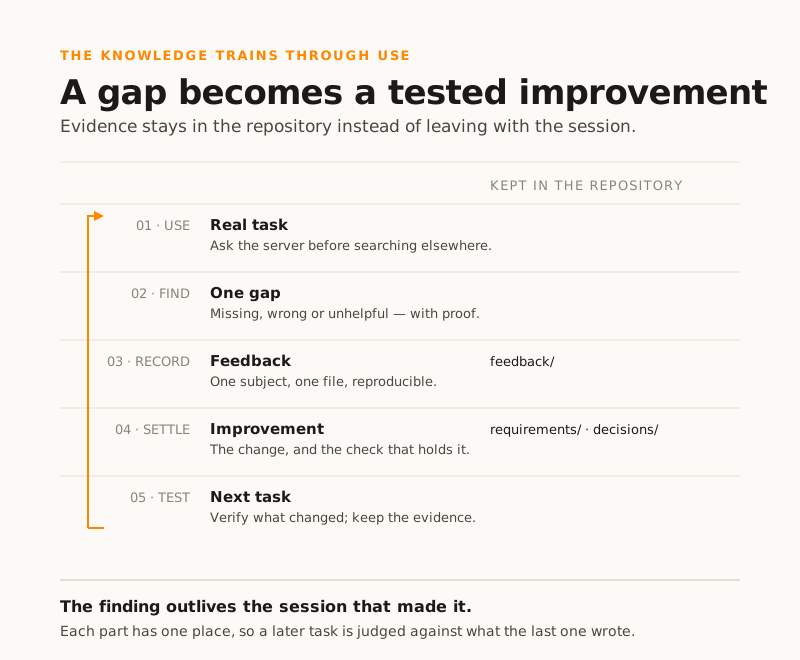
Working a feedback off#
bin/cli feedback:archive feedback/2026-07-31-…-the-lookup-found-nothing.mdbin/cli feedback:archive feedback/2026-07-31-…-the-lookup-found-nothing.mdThat moves it to feedback/archive/ and stamps it closed. The commit that
moved it is readable. typo3_feedback_list with status="closed" lists the
archived feedback with the commit subject that closed each one, which is what
the agent that reported it can see. Write the subject so it answers "what came
of my feedback".
One feedback per commit where possible. When one change closes several, archive all of them in that commit, one call, since they are one commit. Mention them in the commit body.
The archive#
Nobody deletes a feedback anywhere. What it holds is a session's report about this server. Which skill activated, which calls the task needed, what it had to establish from the checkout or from its own knowledge instead. That is evidence about this server that nothing else in the repository has. The requirement it established says what must be true from now on. It does not say what a session in somebody else's agent ran into on a Tuesday. That is the half worth a read when the next one runs into it too.
The archive is also what makes the closed half of typo3_feedback_list
usable. A feedback read from a commit was a filename and a subject, with the
category, the tools and the model gone with the file. So only the open half
could answer a query about one tool. Both halves are now the same files read the
same way.
The feedback worked off before the archive existed came back into it from the
commits that deleted them. Those carry the commit that closed them in their own
front matter: closed:, commit: and subject:. They all moved in one
commit, and that move says nothing about any of them. The commit that archived a
feedback since then answers for it.
Where the answer goes#
Archiving the feedback takes the question out of the open ones, and the commit
message records the answer. What outlives both goes to four places, and only
todo/ is this workflow's. requirements/, decisions/ and the
documents are the record this repository keeps whether or not a feedback
produced an entry. How to write each one has a page of its own:
Writing a requirement and Writing a decision, and going back to one.
requirements/— what must be true from now on. A feedback is a question. The requirement it established has to hold while everything around it changes. So it stands with what holds it to that: a test, ornot guarded. An accepted requirement nobody has implemented yet is in the same group, marked open, decided and not done. Add the entry in the commit that works the feedback off. The test declares the entry it holds with#[Requirement], andbin/cli requirements:coverwrites that into the entry. So the two have their names in the one commit and in one place. An entry goes only when somebody withdraws the requirement.decisions/— what the change rests on. When it rests on an assumption that could later turn out wrong, record the assumption. Record what evidence there was at the time, and what would show it wrong. One decision is one file, in the group its id names, and the entry opens with the decision in one sentence. Not every commit earns one; a change nobody would need to reconsider does not. When evidence later disproves an assumption, correct the entry in place rather than delete it. The wrong assumption is the useful part, because it names where the next one is likely to sit.todo/— the order of the work, and where the last session stopped. The other files say what must be true, what somebody asked and what somebody assumed. None of them says what to do next. A session can end anywhere, and the next one starts with a read of this. One todo is one file. It names what it serves and what the next concrete step is, and it goes when done rather than gets a tick. Where it sits says whether it is the queue, what recurs, what waits on an answer nothing here can give, or what stays as reference. A queued one carries the priority that decides how soon. That is whatbin/cli todo:nextreads and whatbin/cli todo:checkholds.knowledge/documents/anddocumentation/— the thing itself, where the other three would describe it instead. What the caller lacked is a document in the corpus, which is what this server hands out. What a session at work here lacked is a page underdocumentation/. Which of the two, and which of them a judging run may write rather than queue, is Judging a feedback.
Unresolved entries#
The three states that mean unfinished are legitimate. A principle no test can hold and a decision nothing has come back about are not defects, so no check may fail on them. That is exactly why nothing read them for as long as they existed.
bin/cli unresolved:list is that read; bin/cli todo:next opens with it
and bin/cli repository:check closes with it. It names every requirement
nothing answers for and says whether a queued todo names it. That comes from
what the queue declares it serves. So the page that lists what deliberately
stays out of the queue does not count as a taken one. It gives the oldest open
decision as the one the repository has moved furthest away from.
Standing on that list is not the problem. An entry with no todo that names it is
a decision nobody has taken. A session owes it that decision, a todo, or the
sentence in decisions/ that says why not.